
Tuesday, 10 May 2016

Saturday, 7 May 2016
How to save taxes as a salaried individual?

Salaried individuals are one class of people that have to pay
maximum taxes in our country. This often leads to disappointment among salaried
individuals. Of course, who would be happy knowing that half of the hard earned
income has been deducted in the form of taxes? But with the right tax planning
strategies, it is possible to save your income from tax liabilities. Here are
few ways that will help you save taxes as a salaried individual.
Restructure
your salary: We often spend money from our own account on expenses which
are actually company’s or employer’s requirement. For example, if you wear a
uniform for your job’s sake or talk to a client with your own mobile phone.
Such expenses should be certainly covered by your employer. Ask for the
restructuring of your salary, if you are the one who is paying for the
following expenses.
Some allowances which save tax
Conveyance
Newspaper, Books and Magazine
Medical Treatment
Uniform
Telephone and Mobile
Office Entertainment
Make use of
section 80C: Under section 80C, you can avail a maximum tax deduction of
Rs 1 lakh by investing in any of the following options
ELSS(Equity linked saving scheme)
Public provident fund
Life insurance policy
Fixed deposits
National
saving certificates.
Save tax on
rent payment: You may be working outside your city and do not have a
company accommodation. Expenses on rent payment should be deductible from your
taxable income. House rent allowances include 25 % of the total income.
However, the deduction will not be allowed if you own a residential house in
that location.
Reimburse
travel and medical expenses: Personal expenses such as travel
and medical are also tax deductible. Although you will be required to provide
proper receipts and bills in order to claim the deduction. Deduction, under
this category, is limited up to Rs 15,000.
Tax saving
from home loans: As a salaried individual, you will always consider a
home loan option before buying a house. In such case, do not forget to take
into account tax deductions which are applicable to both principal payments as
well as interest payment. Section 80C offers deduction up to Rs 1 Lakh on
principal component of your home loan.
Apart from considering all the above Tax Saving Plans options,
consult a professional tax planner to avoid any last minute hassle. It is
important to start your tax planning well before 31st March and to file your
returns before the 31st of July each year.
Source: http://tax-saving-plans.tumblr.com/post/143984905105/how-to-save-taxes-as-a-salaried-individual
Wednesday, 4 May 2016
Saturday, 30 April 2016
All About Deduction Under Section 80C And Tax Planning

Background for Section 80C of the Income Tax Act (India) / what
are eligible investments for Section 80C:
Section 80C replaced the existing Section 88 with more or
less the same investment mix available in Section 88. The new section 80C has become effective
w.e.f. 1st April, 2006. Even the section
80CCC on pension scheme contributions was merged with the above Section
80C. However, this new section has
allowed a major change in the method of providing the tax benefit. Section 80C of the Income Tax Act allows
certain investments and expenditure to be tax-exempt. One must plan investments well and spread it
out across the various instruments specified under this section to avail
maximum tax benefit. Unlike Section 88, there are no sub-limits and is
irrespective of how much you earn and under which tax bracket you fall.
The total limit under this section is Rs 1.50 lakh from financial
year 2014-15 / Assessment Year 2015-16. Before FY 2014-15 the limit was Rs. 1
Lakh. Under this heading many small savings schemes like NSC, PPF and other
pension plans. Payment of life insurance premiums and investment in specified
government infrastructure bonds are also eligible for deduction under Section
80C
Most of the Income Tax payees try to save tax by saving under
Section 80C of the Income Tax Act.
However, it is important to know the Section in to so that one can make
best use of the options available for exemption under income tax Act. One important point to note here is that one
can not only save tax by undertaking the specified investments, but some
expenditure which you normally incur can also give you the tax exemptions.
Besides these investments, the payments towards the principal
amount of your home loan are also eligible for an income deduction. Education
expense of children is increasing by the day. Under this section, there is
provision that makes payments towards the education fees for children eligible
for an income deduction
Sec 80C of the Income Tax Act is the section that deals with
these tax breaks. It states that qualifying investments, up to a maximum of Rs.
1.50 Lakh , are deductible from your income. This means that your income gets
reduced by this investment amount (up to Rs. 1.50 Lakh), and you end up paying
no tax on it at all!
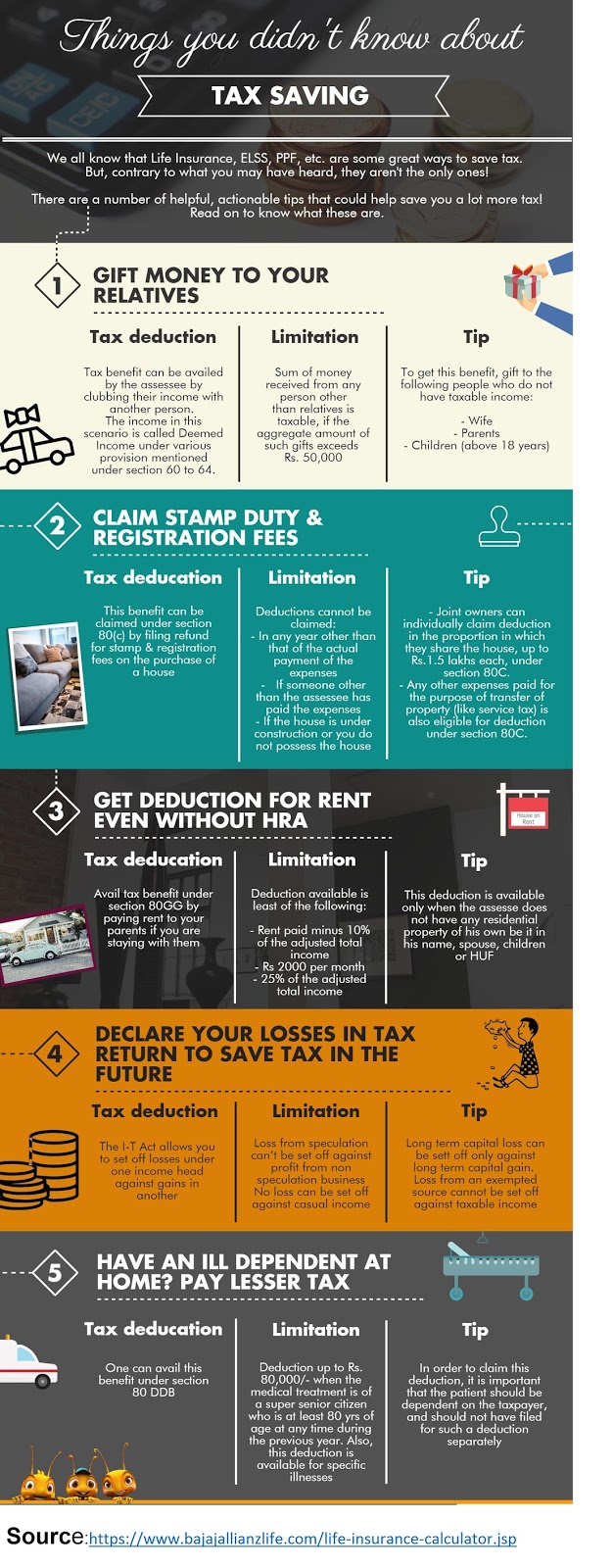
This benefit is available to everyone, irrespective of their
income levels. Thus, if you are in the highest tax bracket of 30%, and you
invest the full Rs. 1.50 Lakh, you save tax of Rs. 45,000. Isn’t this great?
So, let’s understand the qualifying investments first.
Qualifying
Investments
Provident
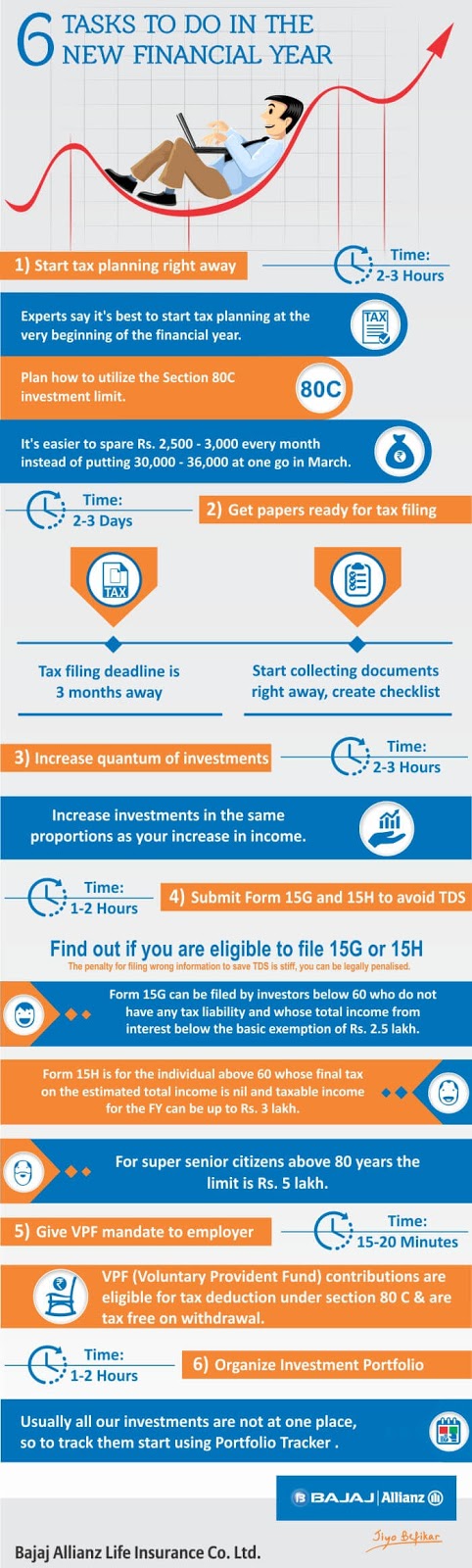
Fund (PF) & Voluntary Provident Fund (VPF): PF is
automatically deducted from your salary. Both you and your employer contribute
to it. While employer’s contribution is exempt from tax, your contribution
(i.e., employee’s contribution) is counted towards section 80C investments. You
also have the option to contribute additional amounts through voluntary
contributions (VPF). Current rate of interest is 8.5% per annum (p.a.) and is
tax-free.
Public
Provident Fund (PPF): Among all the assured returns small saving schemes,
Public Provident Fund (PPF) is one of the best. Current rate of interest is
8.70% tax-free (Compounded Yearly) and the normal maturity period is 15 years.
Minimum amount of contribution is Rs 500 and maximum is Rs 1, 50,000. A point
worth noting is that interest rate is assured but not fixed.
Life
Insurance Premiums: Any amount that you pay towards life insurance
premium for yourself, your spouse or your children can also be included in
Section 80C deduction. Please note that life insurance premium paid by you for
your parents (father / mother / both) or your in-laws is not eligible for
deduction under section 80C. If you are paying premium for more than one
insurance policy, all the premiums can be included. It is not necessary to have
the insurance policy from
Home Loan
Principal Repayment: The Equated Monthly Installment (EMI) that you pay
every month to repay your home loan consists of two components – Principal and
Interest. The principal component of the EMI qualifies for deduction under Sec
80C. Even the interest component can save you significant income tax – but that
would be under Section 24 of the Income Tax Act. Please read “Income Tax (IT)
Benefits of a Home Loan / Housing Loan / Mortgage”, which presents a full
analysis of how you can save income tax through a home loan.
Stamp Duty
and Registration Charges for a home: The amount you pay as stamp duty
when you buy a house, and the amount you pay for the registration of the
documents of the house can be claimed as deduction under section 80C in the
year of purchase of the house.
Infrastructure
Bonds: These are also popularly called Infra Bonds. These are
issued by infrastructure companies, and not the government. The amount that you
invest in these bonds can also be included in Sec 80C deductions.
Pension
Funds – Section 80CCC: This section – Sec 80CCC – stipulates that an
investment in pension funds is eligible for deduction from your income. Section
80CCC investment limit is clubbed with the limit of Section 80C – it maeans
that the total deduction available for 80CCC and 80C is Rs. 1.50 Lakh. This
also means that your investment in pension funds up to Rs. 1.50 Lakh can be
claimed as deduction u/s 80CCC. However, as mentioned earlier, the total
deduction u/s 80C and 80CCC cannot exceed Rs. 1.50 Lakh.
Senior
Citizen Savings Scheme 2004 (SCSS): A recent addition to section 80C
list, Senior Citizen Savings Scheme (SCSS) is the most lucrative scheme among
all the small savings schemes but is meant only for senior citizens. Current
rate of interest is 9.20% per annum payable quarterly. Please note that the
interest is payable quarterly instead of compounded quarterly. Thus, unclaimed
interest on these deposits won’t earn any further interest. Interest income is
chargeable to Best Tax
Saving Plan . The account may be opened by an individual,
Who has attained age of 60 years or above on the date of
opening of the account?
Who has attained the age 55 years or more but less than 60
years and has retired under a Voluntary Retirement Scheme or a Special
Voluntary Retirement Scheme on the date of opening of the account within three
months from the date of retirement.
No age limit for the retired personnel of Defense services
provided they fulfill other specified conditions.
Source: http://bestsavingsplan.tumblr.com/post/143625123529/all-about-deduction-under-section-80c-and-tax
Friday, 29 April 2016
Monday, 11 April 2016

Friday, 4 March 2016
Quick tips to save tax through insurance

Come March and all of us will be busy in calculating our tax
liabilities. In fact, most organisations start asking for proofs of investment
under tax exempted instruments by January itself.
Thus, this is the time when one can review his or her tax
liabilities and take necessary actions. As you may already be aware that this
year the income tax exemption limit towards life insurance has increased from
Rs 1 lakh to Rs 1.50 lakh. It is a significant jump of flat 50 per cent. This
exemption can be claimed under section 80C of the Income Tax Act.
But, are you going to take advantage of this move? Of
course, you should. Unfortunately, there are millions of people who had been
investing in insurance as per the previous limit of Rs 1 lakh. But it is still
not late and you can take a corrective action.
What about pension
funds?
If you are thinking of investing in a long-term pension
fund, then you can claim tax benefit under section 80CCD of the Income Tax Act.
The deduction under this section can be availed up to Rs 1 lakh.
Although, the pension which you receive after the policy
tenure is applicable to income tax. The percentage of tax depends upon the
amount of your gross taxable income.
Section 80 CCE of the Act specifies that the total limit of
deduction under the abovementioned sections – 80C and 80CCD comes to Rs 1.50
lakh.
Deduction under
health insurance
After life insurance, you can further claim income tax
deduction with respect to premium paid towards health insurance. There is a
provision of deduction up to Rs 15,000 towards health insurance.
This is further added up by Rs 20,000 towards health insurance
premium paid for parents above 60 years of age. If parents are below 60 years,
then the tax deduction would be Rs 15,000. Tax payers, who fall in the category
of senior citizens, can also claim the deduction of Rs 20,000.
Are you worried about
low returns?
A large number of people appreciate life insurance plans
because of their dual benefit of risk coverage and tax exemption. But there is
always a concern on the low rate of returns offered by these plans. It is
observed that most plans offer annual returns in the range of 5-8 per cent.
This rate of return is even lower than average rate of
inflation. Thus, investing in insurance is not preferred by people who wish
high return on investment. They may invest some amount to cover risk and get
some exemption but they always aspire to invest in other instruments such as
equities and real estate. Is there a solution?
Well, we cannot say anything about real estate, but yes, you
can always invest in equities and insurance altogether. Unit Linked Insurance
Plan (ULIP) are the potential solution.
These plans are also recognised for Tax
Saving Plans exemption under section 80C and there is an added benefit of
investing in equity markets. You can always the allocation of your premium in
traditional debt instruments and equities to balance risks. For instance, you
can specify that 40 per cent of your premium should be invested in equities and
the rest in government securities. This helps is enhancing the average rate of
returns on you investment.
For instance, you invest Rs 1 lakh in ULIPs, specifying that
Rs 60,000 should be invested in government securities and the rest in equity
markets. Now, in a year if your plan generate 9 per cent on government
securities and 15 per cent from equity markets, your total return will be as:
Rs 5,400 from securities and Rs 6,000 from equities. This will bring you a
return of Rs 11,400 in total – 11.4 per cent returns per annum.
In the long run, you are able to enjoy the power of
compounding. ULIPs have a lock-in period of 3-5 years, and you are somehow
bound to think long term. If you tend to withdraw the premium before this
period, the deductions are as high as 30 per cent.
From these perspectives, all the insurance plans have such
conditions in place. That means, if you withdraw premium amount before a
certain period, which is generally 3-5 years, then the penalties fall in the
range of 30 per cent. Thus, it is better to invest in insurance from a long
term perspectives, and it really works, providing you a sizeable corpus.
Subscribe to:
Posts (Atom)